The EU has initially agreed that the target for the content of recycled materials in new cars is 15%.
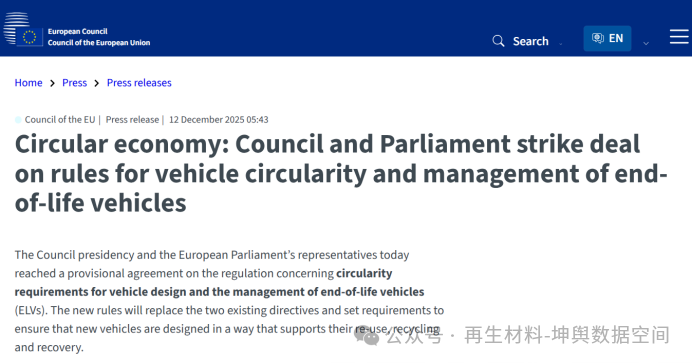
On December 12, 2025, the rotating presidency of the Council of the European Union and representatives of the European Parliament reached a provisional agreement on the requirements for vehicle design circularity and regulations on end-of-life vehicle management. The new regulations will replace the existing two directives and set relevant requirements to ensure that the design of new vehicles can support the reuse, recycling and regeneration of vehicles.
This new regulation is a cornerstone of the European Green Deal and the Circular Economy Action Plan, aiming to promote the transformation of the automotive industry towards a more circular model. It covers the entire life cycle of vehicles, from design and production to end-of-life disposal, with the dual goals of enhancing environmental protection and ensuring the proper functioning of the single market. One of its key tasks is to address the long-standing issue of "missing vehicles" by strengthening traceability and control measures.
Danish Environment Minister Magnus Heunicke said: "This provisional agreement marks an important step for the European automotive industry towards a circular economy. We have successfully agreed on a strong framework that closes loopholes, ensures that valuable materials remain within the EU's economic system, and curbs the export of highly polluting vehicles that do not meet roadworthiness standards to third countries. The new regulations will drive innovation in sustainable design and create a stronger, cleaner market for materials and components."
The main contents of the agreement are as follows:
1. Expansion of regulatory scope
The range of vehicle categories covered has significantly increased, exceeding the scope of the original directive, and incorporating a larger proportion of vehicles and components in the EU into the requirements of the circular economy.
It continues to apply fully to passenger cars and light commercial vehicles, but extends the processing requirements (collection, purification, mandatory component removal) to all conventional heavy-duty vehicles (such as trucks), motorcycles, and special-purpose vehicles (both small and heavy-duty). Manufacturers of small heavy-duty special vehicles are exempted.
2. Circular Design and Recycled Materials
The target for the proportion of recycled plastics in new vehicles has been lowered: it must reach at least 15% within six years after the regulation comes into effect and increase to 25% within ten years (this is consistent with the initial position of the Council of the European Union and reverses the 20% target for the first phase proposed by the European Parliament).
20% of recycled plastics must come from closed-loop recycling (i.e., materials recycled from end-of-life vehicles).
The Commission will conduct a study within one year after the regulation takes effect and set future targets for other materials (such as recycled steel, aluminum, magnesium, and critical raw materials), with a focus on using post-consumer waste.
3. Status and Traceability of End-of-Life Vehicles
A clear set of standards has been formulated to explicitly determine when a vehicle is deemed a discarded vehicle (i.e., an end-of-life vehicle). Once a vehicle meets these standards, it must be handled by an Authorized Treatment Facility (ATF) and must not be legally exported or resold as a used car.
A strict framework for the transfer of vehicle ownership between economic operators has been established. For the transfer of vehicle ownership between private individuals, a risk-based approach is adopted, requiring documentation to be provided in situations most likely to result in vehicle loss, such as: the insurance company declaring the vehicle a total economic loss; or the transaction being completed entirely through an online platform without any actual handover of the vehicle between the buyer and the seller.
4. Extended Producer Responsibility
The principle of Extended Producer Responsibility (EPR) has been significantly strengthened, making producers bear financial and organizational responsibilities for the entire life cycle of their vehicles, from eco-design to the free recycling and disposal of end-of-life vehicles.
To ensure uniform implementation within the EU, a cross-border Extended Producer Responsibility (EPR) system will be introduced.
5. Export Control:
It is prohibited to export used vehicles that are no longer roadworthy, to ensure that the EU fulfills its commitment not to cause pollution to third countries and to keep valuable resources within its territory. The ban will come into effect five years after the regulation takes effect.
The interim agreement must be approved by the Council of the European Union and the European Parliament before it is formally adopted. The new regulations will come into force two years after they take effect.
Source: Plastic Recycling WeChat Official Account