The EU’s new regulations on waste plastic exports took effect at the end of May.
A set of key new provisions under the EU Waste Shipment Regulation (WSR) officially entered into force on 21 May 2026. A profound transformation is underway for the global recycling sector, particularly enterprises reliant on waste plastic supplies originating from the EU.
1. Mandatory Digital Implementation – Full Launch of DIWASS System
As of 21 May 2026, all information and documents relating to waste entering, exiting or being transported cross-border within the EU must be electronically submitted and exchanged through the EU Central Digital Waste Shipment System (DIWASS) or interconnected national systems. Paper-based formalities are officially discontinued.
However, special attention should be noted that not all waste shipments are subject to the Prior Informed Consent (PIC) procedure. Pursuant to the Waste Shipment Regulation:
Waste destined for disposal, hazardous waste and most mixed waste intended for recycling remain subject to the PIC procedure, which must be completed digitally via DIWASS.
By contrast, non-hazardous waste listed on the Green List for recycling within the EU and OECD countries is only subject to general information requirements: basic details including waste volume, recycling route, origin and destination shall be submitted through the system, with no need for case-by-case prior approval from competent authorities of respective countries.
Under the new WSR rules, all transport contracts must incorporate more detailed clauses specifying exact treatment facilities, waste codes and types of recovery operations. Existing contracts also need to be reviewed and updated in accordance with Article 8 of the Regulation. While this inevitably increases compliance costs for enterprises, it substantially boosts full-chain transparency.
2. Full Tightening on Waste Plastic Exports: PIC Procedures and Export Ban to Non-OECD Nations
The new rules impose unprecedented stringent restrictions on waste plastic exports. Different effective dates need to be distinguished:
Different effective dates need to be distinguished: starting from 21 May 2026, all documentation submissions for waste plastic shipments must be completed electronically via the DIWASS system. However, most substantive revisions to export provisions shall take effect on 21 May 2027.
Effective 21 November 2026, the EU will introduce a blanket ban on exports of non-hazardous plastic waste to all non-OECD countries for a period of 30 months, concluding on 21 May 2029. This ban enters into force earliest and carries the most immediate and significant impacts among all current regulatory measures.
PIC procedures will become mandatory as from 21 May 2027 for waste plastics exported to OECD countries, as well as non-hazardous plastic waste shipped to authorised non-OECD nations. Even clean waste plastics falling under Basel Convention entry B3011, such as shredded scrap and single-polymer feedstock, which were previously traded freely, will no longer qualify for unrestricted export under the Green List regime.
According to Dr. Huang Chuqi, CEO of Botong High-Mei Industrial Co., Ltd., following communications with suppliers based in Spain and Germany, some companies argue that where their facilities hold valid permits and process waste plastics into recycled feedstock via the R3 recovery process, the resulting output should be classified as end-of-life plastics rather than waste. Should regulators endorse this interpretation, it could deliver transitional relief for the industry.
In addition, several Northern European plants contend that unused plastic pellets, reusable bulk bags, plastic rolls and ropes qualify for continued export as finished products instead of waste, given their suitability for direct reuse across other industrial sectors.
Nevertheless, Dr. Huang cautions that criteria governing non-waste classification vary from country to country, leaving final compliance requirements pending official clarification.
3. ESM Audit Requirements: Another Compliance Threshold for 2027
Starting from 21 May 2027, any EU exporter intending to ship waste (including plastic and other Green List wastes) to overseas facilities, regardless of whether located in OECD member states, must hold a valid independent third-party audit report verifying the receiving facility’s capacity for Environmentally Sound Management (ESM). Such audit certificates remain valid for two years. Shipments lacking a valid ESM audit report shall be deemed illegal.
This requirement shifts substantive liability onto exporters: companies must not only maintain internal compliance but also vouch for the environmental performance of their overseas partners. Exports are required to cease immediately should the receiving facility fail the audit, compelling the entire supply chain to upgrade to elevated compliance standards.
4. Progress on Import Authorisation Applications for Non‑OECD Countries
Pursuant to the Waste Shipment Regulation, competent authorities of non-OECD countries intending to import waste from the EU shall notify the European Commission of their intention and demonstrate their capacity to treat such waste in an environmentally sound manner in compliance with Annex VIII and Annex IX of the Regulation. This constitutes a prerequisite for obtaining eligibility to receive waste imports originating from the EU.
Non-OECD jurisdictions wishing to continue receiving waste shipments from the EU originally faced an application deadline of 21 February 2025. By the cut-off date, applications had been submitted by the following countries and Chinese regional administrative regions:
Bangladesh, Bosnia and Herzegovina, Egypt, El Salvador, Georgia, Hong Kong of China, India, Indonesia, Kazakhstan, Malaysia, Mauritius, Moldova, Monaco, Montenegro, Morocco, Nigeria, North Macedonia, Oman, Pakistan, the Philippines, Saudi Arabia, Serbia, Singapore, Sri Lanka, Taiwan of China, Thailand, Togo, Tunisia, Ukraine, Vietnam.
In addition, the Lao People's Democratic Republic and Andorra submitted their respective applications in June and July 2025. Although filed after the prescribed deadline, their applications remain under consideration.
Particular attention should be drawn to the following: countries that failed to submit applications by 21 February 2025 remain eligible to file supplementary applications with the European Commission, which will still be reviewed. There is, however, no guarantee that assessments of such late submissions can be finalised prior to the adoption of the initial authorised country list, scheduled for November 2026. Once the list is finalised, exports of non‑hazardous waste to any non‑OECD nations absent from the list will be prohibited.
This timeline is of critical importance to the industry: November 2026 marks both the effective date of the export ban on non-hazardous plastic waste and the release of the first authorised country list. Going forward, only non-OECD jurisdictions featured on the list will qualify to continue receiving non-hazardous waste (including approved waste plastics) originating from the EU. The 32 applying countries and Chinese regional jurisdictions are currently undergoing evaluation by the European Commission, whose findings will directly shape the future flow of waste plastics.
5. Industry Data and Export Landscape
According to the latest research statistics for 2025: Germany ranks as the world’s largest exporter of plastic waste with an annual export volume of 810,000 tonnes in 2025. The United Kingdom comes in second at 675,000 tonnes, hitting an eight‑year high. Total waste plastic exports from the EU stood at 1.5 million tonnes in 2025, half of which were destined for non‑OECD countries.
Monthly EU plastic waste shipments to non‑OECD economies climbed from an average of 39.6 million kilograms in 2021 to 45 million kilograms per month as of December 2025, equivalent to 280 shipping containers every single day. Key destination nations include Turkey (the top importer at present), Malaysia, Indonesia and Vietnam.
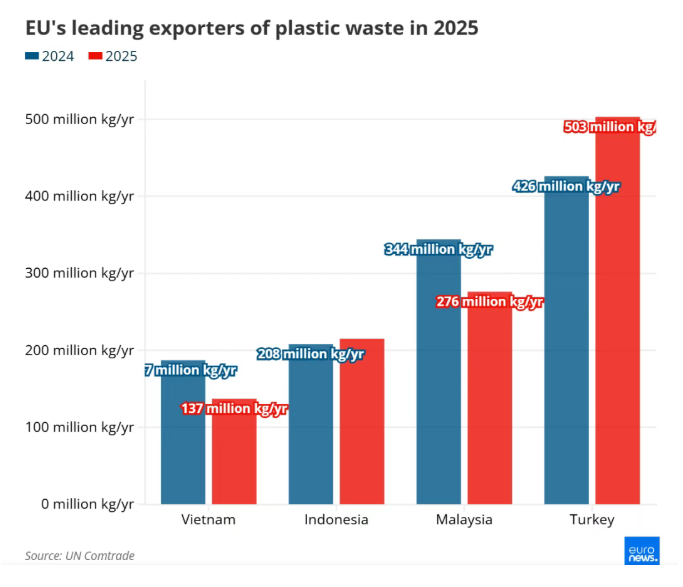
These figures underscore the far-reaching impacts of the upcoming ban: millions of tonnes of low-grade waste plastics per annum will either have to be treated within the EU or rerouted to a small number of authorised non-OECD countries.
6. Industry Outlook: Short-term Growing Pains and Long-term Transformation
Besides amendments to the Waste Shipment Regulation (WSR), the European Commission has finalised implementing rules governing the calculation, verification and reporting of recycled plastic content in single-use plastic beverage bottles. Two core policies under these rules will profoundly reshape the long-term landscape of the global waste plastic recycling sector. First, chemical recycling technologies are officially recognised yet subject to stringent regulatory criteria. Second, a three-year transitional grace period together with protective entry thresholds is established for recycled feedstock sourced from outside the EU.
Overall, the EU’s strategy has become increasingly clear: endure transitional pains in the short term, curb outbound waste exports and channel investment into chemical recycling in the medium term, and build a closed-loop market via certification and mass-balance rules over the long haul, while shielding its domestic recycled plastics industry with transitional grace periods.
Nevertheless, market disruption, cost inflation and supply chain disruptions during the transition phase are almost inevitable. For the global recycling industry, this represents both a formidable challenge and an opportunity for industrial reshuffling and upgrading to elevated operational standards. Global waste plastic trade flows will undergo drastic restructuring over the next two years. Only enterprises that proactively align with the EU’s new regulatory standards, secure official import authorisation or obtain relevant certifications can survive amid the revamped trade landscape.
Source references: European Commission, Fukutomi Gazette, Euronews, etc.