Europe's Plastic Circular Economy Faces a 'Precipitous Slowdown': Growth Rate Slumps from 13.6% to 1.2%
Recently, Plastics Europe released its biennial report, The Circular Economy for Plastics – A European Analysis. The report provides the latest (2024) data and insights into Europe's plastic circular transition, covering trends in circular plastics production, processing, consumption, and trade, as well as waste management statistics.
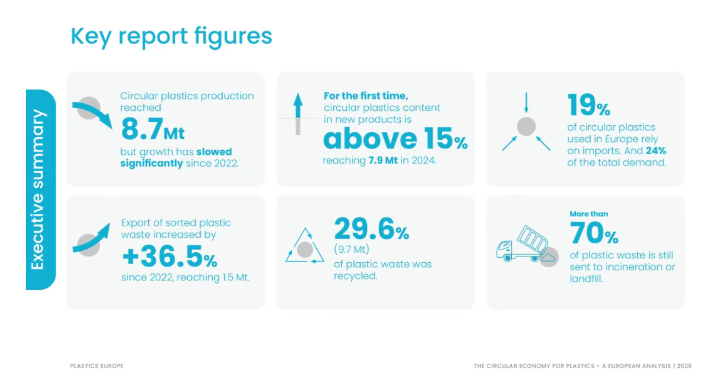
The report reveals that although Europe still holds a global lead in the share of circular plastics production, its growth rate has slowed significantly, posing severe challenges to the industry's development.

1. Circular Plastics Production Growth Rate Plummets from 13.6% to 1.2%
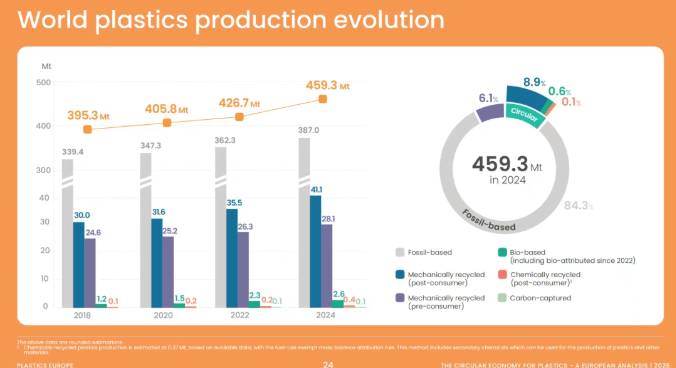
The report indicates that in 2024, circular plastics (including mechanical recycling, chemical recycling, bio-based, and carbon-captured plastics) accounted for 15.8% of total plastic production in Europe, reaching a volume of 8.7 million tonnes (8.7 Mt). However, the growth in this share was largely driven by the contraction of fossil-based plastic production—which fell by 8.3% to 43.3 Mt—rather than substantial expansion in circular plastics.
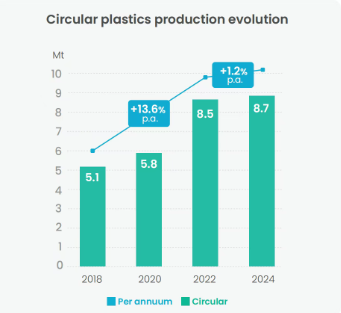
Europe's annual growth rate for circular plastics production plummeted from 13.6% in 2022 to a mere 1.2% in 2024. Meanwhile, the global annual growth rate climbed from 5.0% to 7.7%, with total output reaching 44.2 million tonnes (44.2 Mt), accounting for 9.6% of global plastic production.
2. Rising Import Reliance: 19% of Circular Plastics Demand Met Through Imports
In 2024, European plastic processors relied on imports to meet 19% of their demand for circular plastics. Furthermore, when looking at total plastic demand (including fossil-based plastics), the import share reached as high as 24%.
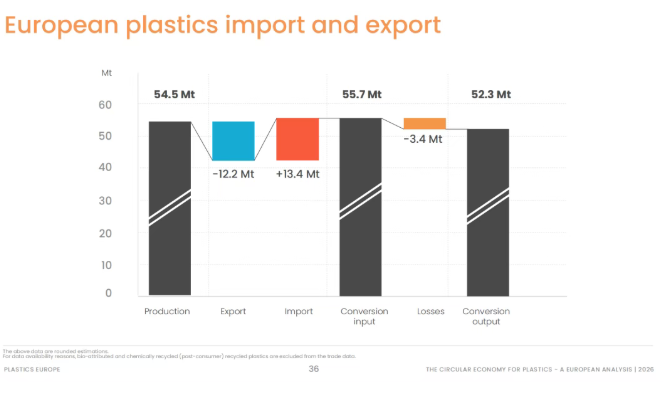
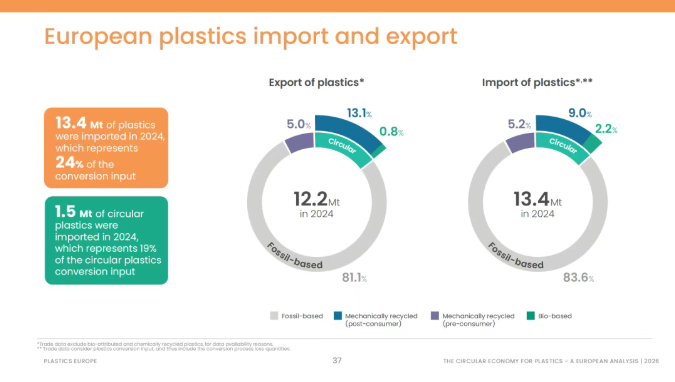
Meanwhile, Europe's exports of sorted plastic waste surged by 36.5% between 2022 and 2024, reaching 1.5 million tonnes, with Turkey and Malaysia as the primary destinations. This trend reflects Europe's competitive disadvantages in areas such as energy costs and recycling capacity.
3.Recycling Rates Rise, Yet 70% of Plastic Waste Still Incinerated or Landfilled
In 2024, out of the 32.7 million tonnes of post-consumer plastic waste collected in Europe, 29.6% was recycled—an 11.5% increase from 2022. However, the remaining 70.4% was still either incinerated (48.9%) or landfilled (21.5%).
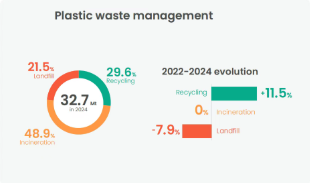
Notably, between 2022 and 2024, the volume of incinerated plastic waste saw no decline, even as exports of sorted plastic waste rose significantly. This indicates that Europe is making slow progress in boosting its recycling capacity and reducing reliance on incineration and landfills.
4. Technology Neutrality and Systemic Integration
The report highlights that mechanical recycling alone cannot achieve full circularity. Although it remains the primary workhorse (with European mechanical recycling output reaching approximately 8.1 Mt in 2024), it is unable to process mixed, contaminated, or complex plastic waste.
Complementary technologies that require accelerated development include:
Solvent-based recycling: Separating polymers using solvents without altering their chemical structure.
Chemical recycling (depolymerization, pyrolysis, gasification): Converting plastic waste into monomers or feedstock oils.
Bio-based plastics: Producing plastics utilizing biomass (such as crop residues and waste oils).
Carbon Capture and Utilization (CCU): Transforming captured CO₂ into raw materials for plastics.
Plastics Europe is calling on the EU to adopt a technology-neutral policy and proposes establishing integrated circular hubs that combine mechanical recycling, chemical recycling and bio-based production facilities to maximize resource efficiency.
(Source: Plastics Europe Report)